Beyond Polling
While simple polling is effective for validation, it wastes valuable CPU cycles. By integrating interrupts into the Zynq-7000 architecture, we transform the system into an event-driven powerhouse. This allows the ARM Cortex-A9 to execute complex algorithms while the AXI DMA handles the heavy lifting of moving data between the PL and DDR memory.
Required Materials
- Hardware: Cora Z7-07S (Zynq-7000)
- Toolchain: Xilinx Vivado + SDK 2018.3
- Debug: Integrated Logic Analyzer (ILA) & Tera Term
DMA Interrupt & Debug Architecture
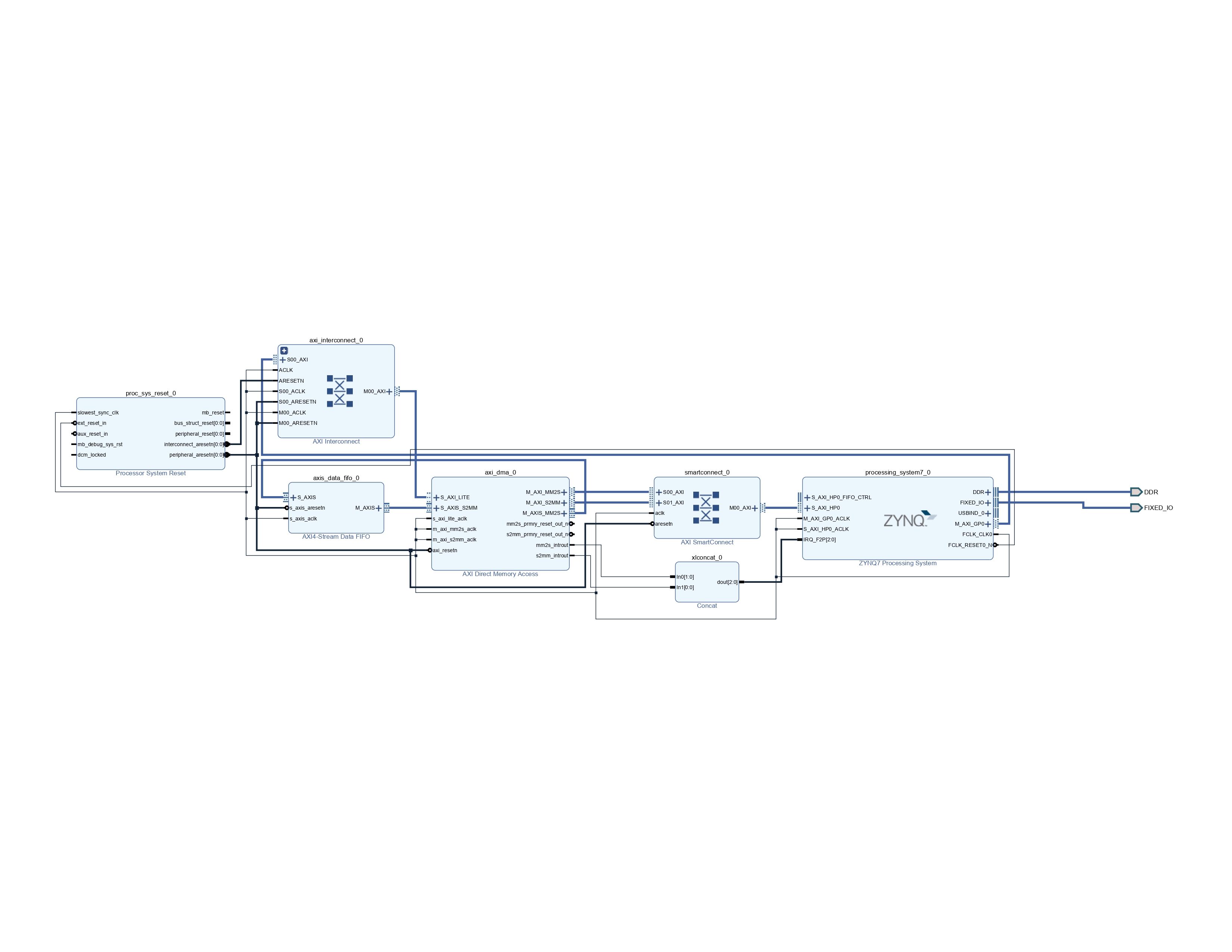
Figure 1: Signal routing using the Concat IP to bridge DMA IRQ lines to the Zynq Processing System.
Hardware Implementation
The hardware transition requires exposing the IRQ_F2P (Fabric to Processor) port on the Zynq IP. Since the AXI DMA provides independent signals for MM2S (Memory to Stream) and S2MM (Stream to Memory), we utilize a Concat IP block to aggregate these signals into a single vector for the Generic Interrupt Controller (GIC).
1. Connect Handlers & Start GIC
static int SetupIntrSystem(INTC * IntcInstancePtr, XAxiDma * AxiDmaPtr, u16 TxIntrId, u16 RxIntrId)
{
    // 1. Initialize Interrupt Controller
    XIntc_Initialize(IntcInstancePtr, INTC_DEVICE_ID);

    // 2. Connect Handlers (Callback functions)
    XIntc_Connect(IntcInstancePtr, TxIntrId, (XInterruptHandler) TxIntrHandler, AxiDmaPtr);
    XIntc_Connect(IntcInstancePtr, RxIntrId, (XInterruptHandler) RxIntrHandler, AxiDmaPtr);

    // 3. Start GIC and enable specific hardware lines
    XIntc_Start(IntcInstancePtr, XIN_REAL_MODE);
    XIntc_Enable(IntcInstancePtr, TxIntrId);
    XIntc_Enable(IntcInstancePtr, RxIntrId);

    // 4. Initialize Hardware Exceptions
    Xil_ExceptionInit();
    Xil_ExceptionRegisterHandler(XIL_EXCEPTION_ID_INT, (Xil_ExceptionHandler)INTC_HANDLER, IntcInstancePtr);
    Xil_ExceptionEnable();

    return XST_SUCCESS;
}
2. The Interrupt Service Routine (ISR)
static void TxIntrHandler(void *Callback)
{
	u32 IrqStatus;
	int TimeOut;
	XAxiDma *AxiDmaInst = (XAxiDma *)Callback;

	/* 1. Identify the Interrupt Source */
	IrqStatus = XAxiDma_IntrGetIrq(AxiDmaInst, XAXIDMA_DMA_TO_DEVICE);

	/* 2. Acknowledge and Clear */
	// It is vital to acknowledge the interrupt immediately to clear
	// the hardware latch and prepare for the next event.
	XAxiDma_IntrAckIrq(AxiDmaInst, IrqStatus, XAXIDMA_DMA_TO_DEVICE);

	/* 3. Filter Spurious Interrupts */
	if (!(IrqStatus & XAXIDMA_IRQ_ALL_MASK)) {
		return;
	}

	/* 4. Error Recovery Logic */
	// If the Error mask is set, the DMA engine has halted.
	// We set a global error flag and initiate a hardware reset.
	if ((IrqStatus & XAXIDMA_IRQ_ERROR_MASK)) {
		Error = 1;
		XAxiDma_Reset(AxiDmaInst);
		TimeOut = RESET_TIMEOUT_COUNTER;

		while (TimeOut) {
			if (XAxiDma_ResetIsDone(AxiDmaInst)) {
				break;
			}
			TimeOut -= 1;
		}
		return;
	}

	/* 5. Completion Assertion */
	// XAXIDMA_IRQ_IOC_MASK indicates "Interrupt on Complete."
	// We set the volatile TxDone flag to notify the main-line code.
	if ((IrqStatus & XAXIDMA_IRQ_IOC_MASK)) {
		xil_printf("---- MM2S Interrupt is Active  ----
");
		TxDone = 1;
	}
}
Pro-Tip: Always use the volatile keyword for completion flags. Without it, the compiler optimizer may assume the variable never changes, causing your main loop to hang indefinitely.
Logic Inspection: The "Why" behind Latency
Using an Integrated Logic Analyzer (ILA), we can observe the micro-timing of these interrupts. A key observation in this project was the duration of the IRQ assertion.
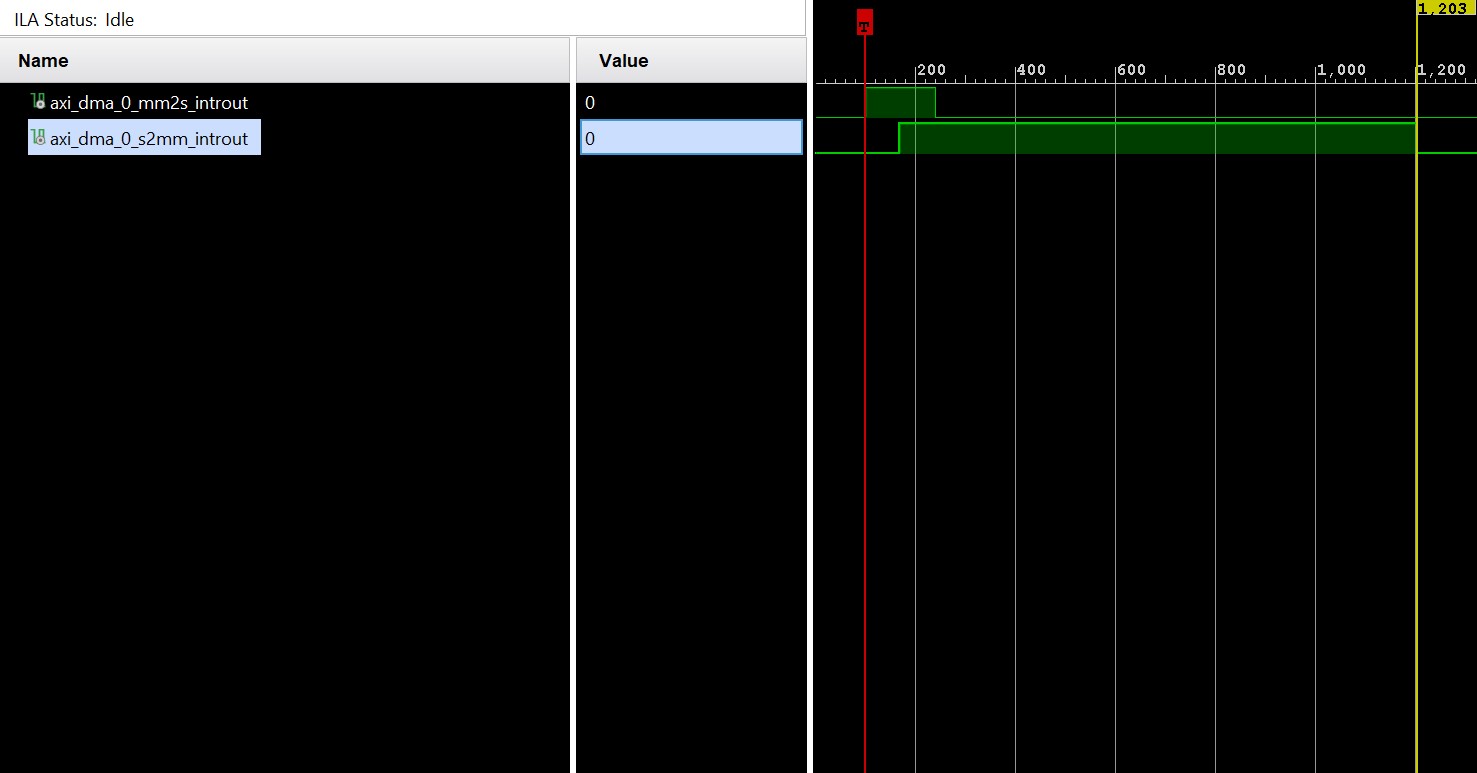
ILA Capture: Note the gap between IRQ rise and de-assertion.
Software Latency Explained
The hardware clears the interrupt almost instantly, but the CPU takes time to finish the first ISR before it can jump to the next. In a baremetal environment, this latency is the cost of context switching and serial logging (xil_printf).
Results & Validation
---- Entering main() ---
---- MM2S Interrupt is Active ----
---- S2MM Interrupt is Active ----
Data valid 0: sent C = received C PASS
...
Successfully ran AXI DMA interrupt Example
---- Exiting main() ---